Custom Rigid Packaging for Premium Products and High-Value Experiences
Rigid packaging is designed for situations where the package itself needs to contribute to the perceived value of the product.
Unlike conventional folding cartons, rigid boxes use substantially thicker structural board and are generally assembled into a stable three-dimensional form. This gives them a different physical presence and allows brands to create more deliberate opening and presentation experiences.
For many premium products, the packaging is not simply protection around the product.
It is part of the product experience.
What Makes Rigid Packaging Different?
The defining characteristic of rigid packaging is its structural construction.
A thick board core provides the box with rigidity and stability, while an exterior wrap creates the finished visual surface.
This construction allows for:
- Substantial walls
- Strong corners
- Stable lids
- Custom inserts
- Hinged structures
- Magnetic closures
- Drawer mechanisms
- Multi-layer presentations
- Premium wrapped surfaces
The result is packaging that feels materially different from a lightweight folding carton.
Rigid Packaging for Luxury Products
Luxury products often depend on presentation as part of their positioning.
Jewelry, watches, fragrance, premium accessories, high-end cosmetics, specialty goods, and other luxury products can benefit from packaging that creates a stronger sense of permanence and craftsmanship.
The goal is not simply to make the box heavier.
The structure, proportions, material, printing, finishing, insert, and opening mechanism should work together to communicate the intended level of quality.
Rigid Cosmetic Packaging
Cosmetic and beauty brands frequently use premium presentation packaging for product collections, gift sets, launches, and limited editions.
A rigid box can organize several products within a fitted insert while providing substantial exterior and interior surfaces for branding.
For example, a skincare collection could use a rigid magnetic box with individual product compartments, while a fragrance presentation could use a custom insert designed around the bottle and accessories.
The structure should always be developed around the actual products rather than relying on a generic interior.
Rigid Packaging for Electronics
Electronics and technology products can benefit from rigid packaging where presentation and organized internal protection are important.
A custom insert can position the primary product alongside accessories, cables, documentation, chargers, or other components.
The result can combine product protection with a structured opening experience.
Rigid Packaging for Jewelry and Watches
Small high-value products require particularly careful internal organization.
Custom trays and inserts can position jewelry, watches, accessories, or other small products while creating a clean presentation when the box is opened.
Interior materials and construction should be selected according to the product, presentation requirements, and desired level of protection.
Rigid Gift Packaging
Rigid construction can provide a more substantial foundation for premium gift packaging.
Corporate gifts, holiday collections, customer appreciation packages, event gifts, and luxury product sets can use rigid boxes to create a more memorable presentation.
The structure can be branded on both the exterior and interior, while custom inserts organize the contents.
Magnetic Closure Packaging
Magnetic closure boxes can create a distinctive opening sequence.
The lid remains aligned with the box while concealed magnets provide the closing force. When the package is opened, the controlled movement can make the product reveal feel more deliberate.
This structure can be particularly effective when the opening experience is an important part of the brand presentation.
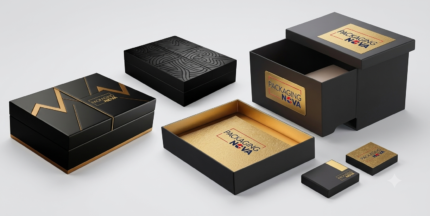
Drawer-Style Rigid Packaging
Drawer boxes introduce a different interaction.
Instead of lifting a lid vertically, the recipient pulls an inner tray outward from an outer sleeve.
This can create a layered reveal in which the product becomes visible progressively.
The sleeve, tray, interior, and product arrangement can all contribute to the overall experience.
Custom Inserts and Product Protection
A premium box can lose much of its value if the product moves around inside it.
Custom inserts solve both a functional and presentation problem.
They can:
- Position products
- Separate components
- Reduce movement
- Organize accessories
- Create defined product locations
- Improve the opening presentation
For multi-product sets, inserts can also guide the customer through the contents.
The insert should be designed after understanding the actual product dimensions, weight, fragility, and arrangement.
Rigid Packaging for Product Launches
Product launches often require packaging that creates a strong first impression for media, influencers, retailers, partners, or customers.
Rigid presentation boxes can combine the primary product with samples, printed materials, accessories, promotional items, or other launch components.
The packaging can be designed around the launch concept while maintaining the brand’s established visual identity.
Rigid Packaging for Corporate Programs
Corporate packaging can be used for executive gifts, employee recognition, partner programs, event kits, promotional campaigns, and client appreciation.
A custom rigid box can bring multiple branded items into one coherent presentation.
For repeat programs, the packaging can be designed as a standardized structure with replaceable artwork or inserts for different campaigns.
Rigid Packaging and Unboxing
The unboxing experience begins before the product is visible.
The weight of the box, texture of the wrap, opening mechanism, interior presentation, insert arrangement, and first product reveal all contribute to the experience.
This is why rigid packaging should be designed as a sequence rather than as a simple container.
The customer should know where to open it, understand how the product is arranged, and encounter the intended visual hierarchy naturally.
Exterior and Interior Branding
Rigid packaging provides unusually large opportunities for interior branding.
The exterior can establish the first impression while the interior can reveal additional messaging, patterns, product information, instructions, or a personalized message.
For brands focused on storytelling, the inside of the box can become an extension of the wider brand experience.
Choosing Between Folding and Rigid Packaging
Not every product requires rigid packaging.
Folding cartons can be more practical when the priorities are lightweight construction, efficient storage, lower material use, or high-volume retail distribution.
Rigid packaging becomes more relevant when the packaging needs to provide:
- Greater structural presence
- Premium presentation
- Reusable characteristics
- Organized product display
- A distinctive opening experience
- Additional internal support
- High perceived value
The decision should therefore be based on the product, distribution model, brand positioning, quantity, and customer experience rather than choosing rigid packaging simply because it appears more premium.
Rigid Packaging for Retail
Rigid packaging can also be used in retail when the product positioning justifies a more substantial package.
Luxury beauty, jewelry, electronics, specialty products, premium accessories, and giftable products may benefit from the additional physical presence.
However, retail packaging must still consider shelf dimensions, storage, shipping, product handling, and operational requirements.
A premium box needs to perform commercially as well as visually.
Sustainability Considerations
Rigid packaging typically uses more material than lightweight folding cartons because of its substantial structural board and wrapping construction.
For that reason, sustainability considerations should be evaluated carefully.
Where appropriate, brands can explore responsible material specifications, recycled-content options, efficient structural dimensions, reusable packaging concepts, and designs that avoid unnecessary components.
However, the environmental characteristics of a rigid box depend on its complete construction, including board, wrap, coatings, adhesives, inserts, and end-of-life infrastructure.
The right objective is not simply to make a rigid box look sustainable. It is to specify the packaging according to the actual environmental and performance requirements.
Designing for Repeatable Production
Premium packaging still needs to be practical to manufacture at the required quantity.
Important considerations include:
- Box dimensions
- Board thickness
- Wrap material
- Closure mechanism
- Insert construction
- Printing method
- Finishing
- Assembly
- Packaging quantity
- Shipping requirements
- Storage requirements
These factors should be considered during structural development rather than after the design has already been finalized.
From Product to Premium Presentation
The strongest rigid packaging projects begin with the product.
What does it weigh?
How fragile is it?
How many components need to fit inside?
How should the customer encounter them?
Will the box be shipped or hand-delivered?
How important is reuse?
What level of branding is appropriate?
The answers determine whether a lid-and-base, magnetic, drawer, book-style, shoulder-and-neck, or another rigid structure makes the most sense.
Packaging Nova can develop the packaging around those requirements, bringing together structure, material, inserts, printing, and finishing into one cohesive presentation.